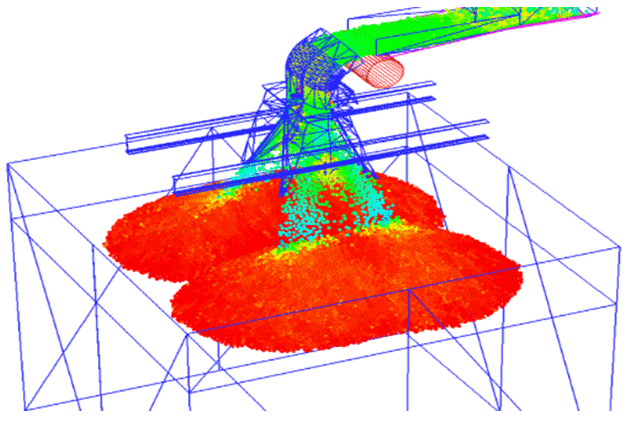
An Australian materials handling innovation that eliminates decades of inefficient ship loading and other conveyor loading practices is being introduced worldwide to increase the buffering capacity between the reclaiming and shiploading functions by up to 20 per cent.
Chute Technology’s patented new profit-enhancing diffused buffer bin loader design for bulk materials conveyor chute systems uses a diffused loader to distribute incoming feed more evenly over a greater area of the surface of stockpiles in the bins, instead of concentrating it onto one large inefficient cone-shaped peak.
“The classic problem of how to fill a rectangular space with a free-flowing material that naturally assumes a rounded conical shape has now been solved,” says Chute Technology Senior Materials Handling Engineer, Gian Naldi. “We believe this innovation is revolutionary, with huge potential for the mining and bulk materials handling industries. We’ve just had it patented approved, so it’s ready for Australian markets,” he said.
A major benefit of the increased bin capacity is that when it is applied to ship loading systems the in-feed conveyor system from the stockpile can be operated continuously to fill the bin whilst the out-feed conveyors run for more time with coal on the belt to service the ship loader at the berth.
“Essentially, it improves the buffering time between reclaim operations and ship loading operations to allow more efficient shiploading,” he said.
“The loading pattern for a typical ship requires up to 20 out-loading feed stops and starts as the ship loader traverses to between individual hatches. The limiting factor for loading ships, amongst other factors, is the reclaim rate from the stockpile. By eliminating the impact of intermittent stoppages of the ship loader on the reclaim system, a more continuous flow of coal is achieved.
The improved process – one of a series from Chute Technology that eliminate potential bottlenecks in materials handling processes – also avoids mechanical wear and tear.
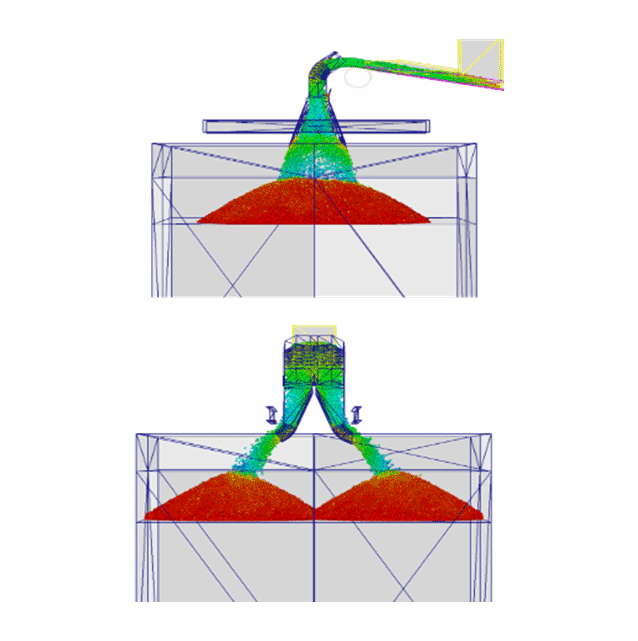
The new system’s four distributed diffusers and spreader deflectors efficiently distribute flowing loads of thousands of tons an hour more evenly over the stockpile being built up, achieving complete filling of bins and doing the job quicker and more cost-efficiently than conventional outlet designs that produce single conical stockpiles.
The design – already proven in a major port loading facility – is applicable to a wide range of conveyor loading systems that would benefit from a curtailing of the need for costly, energy-consuming spreading equipment and space wastage produced by conventional methods.
The technology – and the patented process of which it is part – ensures a more even rise of material being loaded that optimises bin capacity and improves the out-loading efficiency of the system. The application of the technology is being investigated for difficult-to-reach areas of ships’ holds, under decks and farthest from loading hatches. This may result in cutting port time and energy demands and increasing cost-efficiency in competitive markets.
Applications include new and retrofitted systems for mines, mineral process plants, energy plants, railway loading facilities, agribusiness silo and materials handling facilities and factory processing and conveying plants, says Naldi.
“It turns old thinking on its head by eliminating the typical huge cone-shaped top loads deposited from conveyors and instead spreading the load more evenly down around the surface of the bin. The system is engineered to deposit in a more even fashion that rises far more uniformly, giving up to 20 per cent greater bin loading and curtailing the need to spend more money to spread the load to optimise bin capacity or to fit under the overhangs in ships holds, for example.”
Simple concept
“Materials handling professionals who see and are implementing the system say it it’s brilliantly simple in concept and wonder why someone hasn’t thought of it before. But, as with many ideas that are simple in principle, the diffuser loader needs thoroughly sound engineering and to be scaleable to make it work faultlessly in practice.
“We spent years in development before applying the principles in practice, where it has exceeded expectations,” said Naldi.
Naldi says the new technology offers major cost and profit benefits from the totally new approach taken to its construction, in which extensive use is made of heavy pressed plate to form a monocoque product that eliminates a lot of welding and the costs and delays entailed in piecemeal construction.
“Necessity was the mother of invention here – the client involved wanted a product delivered to a strict timeframe and a reduced budget. So we had to totally rethink the manufacturing process to produce a design that could be profitably and cost-efficiently engineered to respond to particular issues. The new system is much easier to custom-engineer to fit into existing and new systems as part of flow improvement.”
Naldi says cost-saving use is made of engineering analysis and DEM principles to eliminate risk by simulating material flow and formation of bin stockpiles before investing money in new and retrofit projects.
This work – highly necessary where projects involve vastly different flowing materials – was successfully employed in a project where the new buffer bin technology is being retrofitted to a loading project involving an increase in the overall shiploading efficiency, resulting in less time at berth for ships.
The upgrade and retrofit in this instance involved a coal deflector (hood) located in the head end of conveyors feeding the bins.
New equipment included a curved deflector with divergent hoods to deliver a vertical product stream into two diffusers (divergent spoons), giving a total of four diffused product outlets.
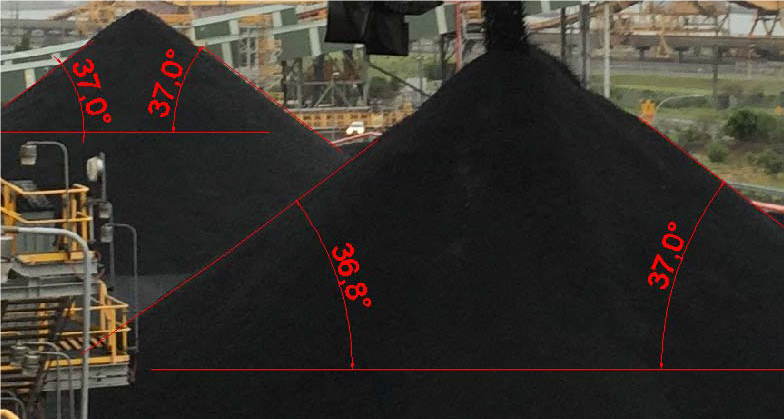
“Design criteria on this project was to increase the working capacity by hundreds of tons over existing fill arrangements, which involved stacking at a rill angle of 37 degrees. The mass stored was evaluated at a material density range of 850kg/m3 to 950kg/m3, to give results in product variation terms familiar to the operators.
“A design objective was to uses as much of the existing equipment as possible to minimise costs and installation time. The new design deals with the existing issues and at the same time will provide an overall increase in the loading system efficiency.
“Similar principles are capable of being designed and installed for very broad range of materials handling technology in use globally. The beauty is the improvements offer a generational major step up in efficiency, attainable at modest cost with high returns.”