Stacker-reclaimers play a critical role in bulk materials handling operations, transferring material between stockpiles and conveyors as part of the production and export process. However, inefficient transfer points can restrict equipment performance, increase maintenance requirements, and limit overall throughput.
Chute Technology was engaged to conduct an engineering review of four large stacker-reclaimers, identifying opportunities to improve the performance and reliability of their material transfer processes.
The review focused on optimising material flow and minimising maintenance across the equipment’s tripper transfer and boom transfer chutes. By addressing the underlying causes of spillage, wear, and flow restrictions, Chute Technology developed a series of practical engineering improvements designed to increase operating efficiency while making maximum use of existing equipment.
The resulting upgrades delivered an increase in train unloading efficiency of up to 18 per cent.
“Improving the performance of an established operation requires more than simply replacing equipment. By understanding how material behaves throughout the transfer process, we can identify the underlying causes of inefficiency and develop targeted solutions that deliver measurable improvements,” says Chute Technology Senior Materials Handling Engineer, Gian Naldi.
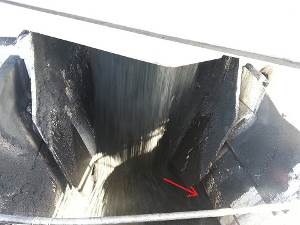
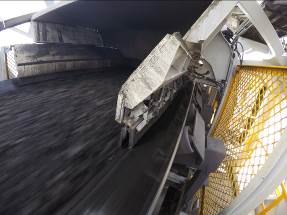
Skirting issues in the spoon area of the stacker reclaimers, left, were one of the series of issues addressed by Chute Technology in its series of improvements to promote smoother and more efficient transfer, right
Addressing the causes of spillage and excessive wear
One of the first priorities was addressing ongoing maintenance issues associated with the two main transfer points on each stacker-reclaimer: the tripper transfer and boom transfer chutes.
Problems included spillage and excessive wear around the loading zones of the receiving conveyors. Wear was particularly evident in the skirtboard wear linings and conveyor belt surfaces.
The underlying issue was insufficient directional control of the material as it moved through the transfer chutes. Rather than being guided smoothly onto the receiving conveyor, material was spreading horizontally on impact, creating excessive pressure against the skirtboards and increasing the potential for spillage.
“Less than optimal directional control was creating unnecessary spillage and increasing maintenance requirements, costing additional time and money,” says Naldi.
Improving the direction and velocity of material flow was therefore central to the engineering solution.
Identifying the root causes of material flow problems
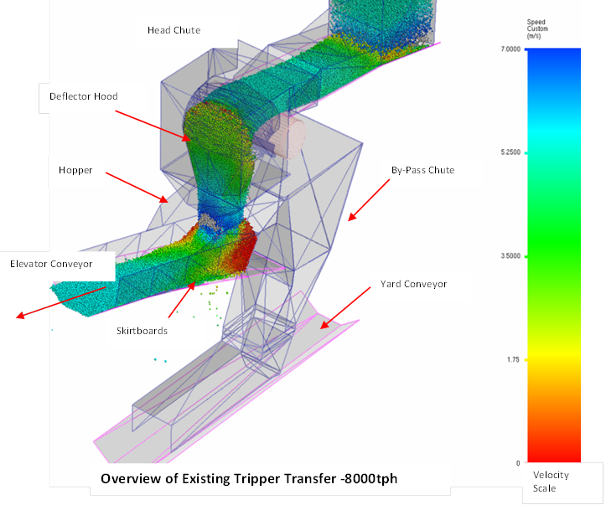
Chute Technology used Discrete Element Method (DEM) simulation to analyse material behaviour through the existing transfer arrangements and identify the causes of poor performance.
The modelling highlighted several design limitations:
- The receiving chute acted primarily as a hopper, rather than guiding material in the direction of the conveyor.
- Material leaving the head chute had insufficient horizontal velocity to align with the receiving belt.
- Material spread horizontally upon impact, creating pressure against the skirtboards.
- Flow stagnated at the impact point before being accelerated by turbulence at the belt surface.
- Uncontrolled sideways material velocity was not adequately contained by the skirtboards.
- Smaller material particles could escape beneath the skirtboards, while trapped material contributed to abrasion of the belt surface.
These conditions contributed to spillage, excessive wear, and increased maintenance requirements, while restricting the equipment’s ability to operate at its full potential.
Engineering a more efficient transfer
Following the DEM analysis, Chute Technology developed an improved transfer chute configuration and used further simulation to assess its performance against the existing design.
This allowed the engineering team to compare material flow through both configurations and progressively refine the proposed solution.
“DEM modelling allows us to investigate how different design configurations influence material behaviour before moving into implementation. By comparing the existing and proposed arrangements, we can reduce design risk and develop a solution that addresses the actual causes of poor performance,” says Naldi.
The design process was iterative, with approximately 20 variations assessed to identify the most effective configuration.
The final design was validated through DEM simulation to confirm that it addressed the original flow issues and satisfied the required performance criteria, including material flow rates, spillage control, and emergency conveyor stops.
Importantly, the solution incorporated as much of the existing equipment as possible, helping to minimise capital costs and installation time.
A staged approach to improved performance
The engineering improvements were implemented in stages to manage costs and provide a pathway for further optimisation.
Initial upgrades demonstrated the practical benefits of the redesigned transfer arrangements, with the proven improvements subsequently replicated across the remaining stacker-reclaimers.
The approach also allowed for future upgrades to individual components as required, ensuring the capability of the overall system could be progressively improved.
“Addressing the transfer points was an important step towards unlocking the full potential of the stacker-reclaimers. Improving material flow, reducing spillage, and minimising wear all contribute to more reliable operation and greater overall efficiency,” says Naldi.
By combining material flow analysis, detailed engineering design, and practical implementation, Chute Technology helps bulk materials handling operations overcome transfer chute limitations and recover performance that might otherwise be lost to inefficient material handling.